
Blog
Why Your Commute Matters: Driving Posture and Spinal Health
Your Commute Is Shaping Your Spine
Whether you’re sitting in rush-hour traffic or logging miles as a delivery driver, your car is a second office—and it’s actively influencing your spine health. Hours spent behind the wheel expose your body to poor positioning, repetitive strain, and constant vibration exposure. The good news: small adjustments to your driving setup and awareness of common habits can significantly reduce spinal stress and prevent the neck, mid-back, and lower-back pain that many commuters accept as inevitable.
The Ergonomics of Seat Positioning
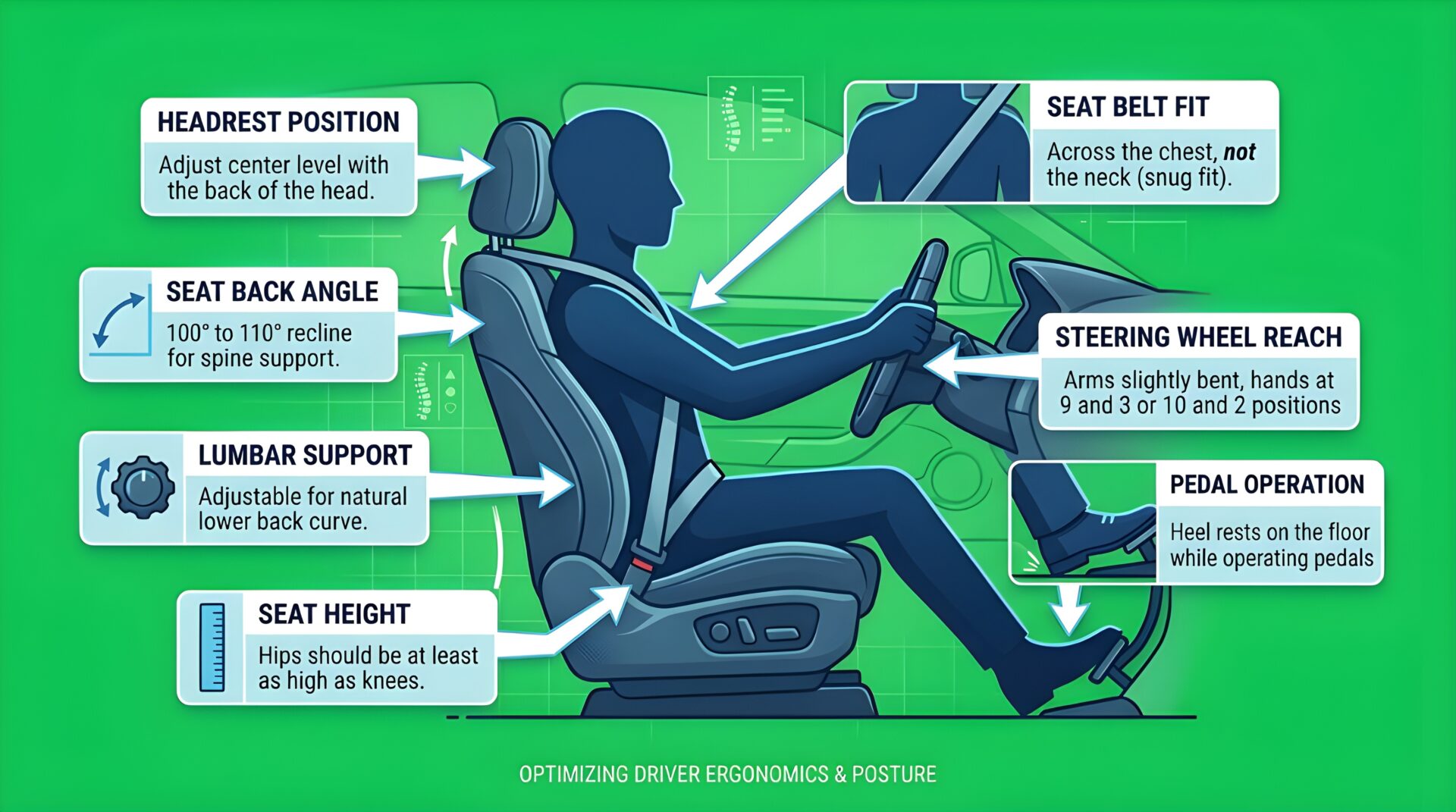
Your seat is the foundation of spinal alignment while driving. Many people slide the seat too close to the steering wheel or recline too far back, both of which force the spine into compromise positions.
- Seat distance: Adjust so your arms are slightly bent when holding the wheel—aim for a 90-120 degree angle at the elbows. Your shoulders should feel relaxed, not stretched or cramped.
- Seat height: Your eyes should align with the middle-to-upper third of the windshield. This keeps your head upright rather than jutting forward, which places excessive load on the cervical spine.
- Lumbar support: Modern cars often have adjustable lumbar curves. Use them. Your lower back needs support to maintain its natural curve during long stretches. If your car doesn’t have lumbar adjustment, a small pillow or memory foam insert behind your lower back can make a real difference.
- Headrest angle: Position it so it supports the middle of your head, not the top. This prevents the forward-head posture that develops when the headrest is too high.
Steering Grip and Upper Body Tension
How you grip the steering wheel affects not just your hands, but your entire upper spine. A white-knuckle grip on the wheel—common in heavy traffic—creates tension in the shoulders, neck, and thoracic spine, leading to fatigue and pain.
Instead, keep your grip light and your hands at the “9 and 3” position (or “10 and 2” if your car’s airbag placement permits). Your shoulders should rest naturally away from your ears. Every few minutes, consciously relax your grip and roll your shoulders back once or twice. This small pause interrupts tension buildup throughout your commute.
Vibration Exposure and Spinal Loading
The constant vibration from the engine, road surface, and suspension doesn’t just feel uncomfortable—it places repetitive microloads on your spine. Delivery drivers and commuters in older vehicles experience more pronounced vibration, which compounds the effect of prolonged sitting.
You can’t eliminate road vibration, but you can reduce its impact by maintaining proper tire pressure (check your owner’s manual), ensuring your vehicle’s suspension is in good condition, and taking breaks every 1-2 hours to step out and move. Movement interrupts the accumulation of vibration stress and allows your discs and joints to reset.
Integrating Chiropractic Care Into Your Commuting Routine
Good driving ergonomics prevent strain, but they don’t address the cumulative wear and postural habits your commute creates. Regular chiropractic care complements your at-the-wheel efforts by identifying early signs of spinal misalignment, relieving tension you may not realize is building, and teaching you corrective movements specific to your driving patterns.
A wellness exam can reveal how your commute is affecting your spine before pain becomes a problem. From there, targeted adjustments and lifestyle guidance ensure your commute supports rather than sabotages your spinal health.
Start Small, Stay Consistent
You don’t need to overhaul your entire driving setup overnight. Begin with seat position, add a lumbar support if needed, and practice shoulder relaxation during red lights. Small, consistent changes compound over weeks and months, resulting in less pain, better posture, and a commute that no longer feels like a threat to your health.
Click here to contact our Office or call Dr. Hogle at (480) 545-7988
Budget Strategy

Rising healthcare costs make it essential to have a clear budget strategy for your health. Instead of reacting to pain after it becomes severe, a proactive approach helps you avoid expensive treatments and maintain long-term wellness.
A smart budget strategy focuses on prevention. When it comes to spine-related pain, research shows that patients who begin care with chiropractic often experience lower overall healthcare costs. Starting with conservative care reduces the likelihood of needing advanced imaging, injections, or surgery later on.
When spinal issues go unaddressed, they tend to worsen over time. This progression often leads to more invasive and costly interventions, including emergency room visits and surgical procedures. By addressing the root cause early through spinal adjustments, many patients prevent this escalation.
Studies continue to show that patients who choose chiropractic first are less likely to require high-cost medical services. They experience fewer hospitalizations, reduced imaging, and lower rates of surgery. This makes chiropractic a practical and effective budget strategy for managing both health and expenses.
Regular adjustments help maintain proper spinal alignment and support nervous system function. When your body functions efficiently, it handles stress better, recovers faster, and reduces the likelihood of chronic issues that require costly care.
Consistency plays a key role in making this approach effective. A long-term budget strategy is not about occasional care—it is about maintaining your health over time. Small, consistent investments in spinal health can prevent large, unexpected medical bills in the future.
In addition to chiropractic care, maintaining good posture, staying active, and managing daily stress all support a strong foundation for health. These habits work together to reduce strain on the body and improve overall function.
A well-planned budget strategy does more than save money—it protects your quality of life. By prioritizing preventive care, you reduce your risk of serious complications and maintain greater independence as you age.
Now is the time to think differently about your health. We offer a proactive, cost-effective way to stay ahead of problems and avoid unnecessary expenses.
If you want to take control of both your health and your finances, consider making regular spinal care part of your budget strategy.
Click here to contact our Office or call Dr. Hogle at (480) 545-7988
Spring Cleaning Your Health

As the seasons change, many people focus on cleaning and organizing their homes—but what about your body?
Spring is the perfect time to reset, recharge, and refocus on your well-being. Spring cleaning your health starts from within, and chiropractic care plays a key role in helping your body function at its best.
Throughout the winter months, people tend to move less, sit more, and deal with increased stress. These habits can lead to poor posture, joint stiffness, and tension in the spine. When your spine is not properly aligned, it can interfere with your nervous system—the system responsible for controlling and coordinating every function in your body.
Dr. Hogle can help restore proper alignment to the spine, allowing your nervous system to communicate more effectively. As a result, many patients notice improved mobility, reduced discomfort, and increased energy levels. This makes it easier to stay active and maintain healthier habits as the weather warms up.
Spring is also a great time to re-evaluate your daily routine. Simple changes like stretching regularly, staying hydrated, and improving posture can make a significant difference in how your body feels. Chiropractic care supports these efforts by keeping your body balanced and functioning efficiently.
In addition, stress often builds up over time without us realizing it. Chiropractic adjustments can help reduce physical tension in the body, which may also promote relaxation and better sleep. When your body is functioning properly, you are better equipped to handle everyday stressors.
Spring cleaning your health is about more than just feeling better today—it’s about setting the foundation for long-term wellness. By addressing spinal alignment and nervous system function, chiropractic care helps your body heal naturally and perform at its highest level.
Click here to contact our Office or call Dr. Hogle at (480) 545-7988
Your Laptop

What Your Laptop Setup is Doing to Your Spine
“I don’t know why my neck and shoulders hurt. I just work on my laptop.”
That’s usually the problem.
Laptops were designed for portability — not posture. When you use one for hours at a desk, on the couch, or at the kitchen table, your spine adapts to the screen position. And the screen is almost always too low.
To see it clearly, you bend your neck forward. Your shoulders round. Your upper back collapses. Over time, this position increases stress on the cervical spine, strains the muscles between the shoulder blades, and overloads the small stabilizing muscles that support proper posture.
The human head weighs about 10–12 pounds. When your head moves just a few inches forward, the effective load on your neck increases significantly. That constant forward-head posture can contribute to tension headaches, upper back tightness, shoulder pain, and even tingling into the arms.
The problem isn’t just discomfort. Prolonged poor positioning changes how joints move and how muscles fire. Some muscles become tight and overactive. Others weaken and stop doing their job. The longer this pattern continues, the more your body adapts to it — and the harder it becomes to correct.
The good news? The solution is simple.
Start by raising your screen so the top third of the monitor is at eye level. Use a laptop stand or even a stack of sturdy books. Then add an external keyboard and mouse so your elbows stay at roughly 90 degrees and your shoulders can relax. Sit with your feet flat on the floor and your lower back supported.
Most importantly, move. Even perfect posture becomes stressful if you hold it too long. Stand up every 30–60 minutes. Stretch your chest. Gently retract your shoulders. Reset your position.
Dr. Hogle can help restore healthy joint motion in the spine and reduce the stress caused by prolonged forward posture. Improving mobility in the neck and upper back allows your body to tolerate daily demands more efficiently. When combined with simple ergonomic changes, it can significantly reduce recurring tension and strain.
Your laptop isn’t the enemy. The setup is.
If your neck, shoulders, or upper back feel tight after a workday, it may be time to address what your workstation is doing to your spine — and correct it before small habits become long-term problems.
Click here to contact our Office or call Dr. Hogle at (480) 545-7988
Neck pain often?

Why Your Neck Pain Isn’t Coming From Your Neck
Neck pain is one of the top reasons people seek chiropractic care. But the real problem often does not start in the neck. You may feel pain at the base of your skull or between your shoulders. However, the true source often comes from poor spinal movement, posture imbalances, or nervous system stress.
Your body works as one connected system. When one area loses mobility or stays under constant strain, other regions compensate. Restricted movement in the upper back or mid-spine often forces the neck to work harder than it should. Over time, this overload creates muscle tension, joint irritation, and pain that feels local but isn’t.
That’s why treatments that only target the neck—like massage, stretching, or heat—often provide short-term relief but fail to fix the root cause.
Modern life constantly stresses the spine. Long hours at a desk, phone use, laptop work, and daily tension all affect posture. Forward head posture and rounded shoulders shift pressure directly into the neck. Even without an injury, the neck absorbs extra strain.
As these patterns continue, your nervous system reinforces them. Tension becomes normal. Pain follows.
Dr. Hogle does not chase symptoms. He evaluates the entire spine to find where movement breaks down. By restoring motion in the upper back and improving alignment, chiropractic adjustments reduce the stress placed on the neck. When the spine moves properly, the neck no longer has to compensate.
Why a Whole-Body Approach Matters
If you only treat where it hurts, the pain often returns. Lasting results come from improving overall spinal function, posture, and movement patterns.
If your neck pain keeps coming back, the source may not be your neck at all. Dr. Hogle identifies the deeper patterns driving your discomfort and corrects them at their origin. The result is better movement, less tension, and longer-term relief.
Click here to contact our Office or call Dr. Hogle at (480) 545-7988
Daily Stress and what your Posture Says About it

Your posture is more than a reflection of how you sit or stand—it’s a physical expression of how your body is responding to daily stress. Long hours at a desk, constant phone use, emotional pressure, and mental overload all leave subtle (and sometimes not-so-subtle) marks on the body. Over time, these patterns can affect how you move, breathe, and feel.
When the body is under chronic stress, the nervous system often shifts into a protective state. Shoulders may round forward, the head drifts ahead of the body, and the upper back stiffens. These postural changes aren’t signs of laziness or weakness—they’re adaptive responses. The body is doing its best to cope with repeated demands, tension, and fatigue.
Forward head posture, for example, is commonly associated with prolonged screen time and mental focus. This position places added strain on the neck, upper back, and shoulders, often contributing to headaches, stiffness, and muscle tension. Similarly, a rigid or collapsed posture can restrict breathing, limiting the body’s ability to shift out of a stress response and into a more relaxed state.
What’s important to understand is that posture and stress influence each other. Daily stress can create postural changes, and those changes can, in turn, reinforce stress signals in the nervous system. This feedback loop is one reason why rest alone doesn’t always resolve physical discomfort. Even when stress levels feel lower mentally, the body may still be holding onto old patterns.
Dr. Hogle looks at posture not as something to “fix,” but as information. By evaluating spinal alignment, joint motion, and muscular balance, chiropractors can identify areas where the body is compensating or under strain. Gentle adjustments help restore movement and reduce tension, giving the nervous system clearer input and more capacity to adapt.
Over time, improved alignment can support better posture, easier breathing, and a greater sense of physical ease. Many people notice that as their posture improves, they also feel more grounded, focused, and resilient in daily life.
Your posture tells a story about how you’re navigating your world. Paying attention to it—and supporting it through chiropractic care—can be a meaningful step toward managing stress and improving overall well-being.
Click here to contact our Office or call Dr. Hogle at (480) 545-7988
Sitting Too Much

Most people don’t think of sitting as a health risk. It feels harmless, comfortable, and productive. Yet the human body was never designed to sit for long periods of time. When sitting becomes the default position—at work, in the car, and at home—it quietly changes how the body functions.
One of the first things affected by sitting too much is posture. As you sit, especially while looking at a screen, the head shifts forward and the shoulders round. This places added stress on the neck, upper back, and shoulders. Over time, muscles become imbalanced—some tighten while others weaken—making good posture harder to maintain even when standing.
Sitting also places constant pressure on the lower spine. The natural curves of the spine flatten, and the discs between the vertebrae experience uneven stress. This can lead to stiffness, discomfort, and eventually chronic lower back pain. Many people are surprised to learn that sitting can put more strain on the spine than standing or walking.
Reduced movement is another major issue. Joints rely on motion to stay healthy. When movement is limited, joints become stiff and less mobile. Muscles that aren’t used regularly begin to weaken, especially the core and glute muscles that support the spine. As these muscles weaken, the body compensates, often leading to pain in the hips, knees, and lower back.
Sitting too much can also affect circulation and the nervous system. Limited movement slows blood flow, which contributes to fatigue and stiffness. The nervous system depends on proper spinal alignment and motion to function efficiently. When the spine is under constant stress, communication between the brain and body may be less effective.
Dr. Hogle can help counteract the effects of prolonged sitting by restoring spinal alignment, improving joint mobility, and reducing tension caused by poor posture. Many people notice improved flexibility, reduced discomfort, and better overall function with regular chiropractic care.
While sitting may be unavoidable, its effects don’t have to be permanent. Standing regularly, stretching, changing positions, and supporting spinal health through chiropractic care can help your body function the way it was designed to—balanced, resilient, and adaptable.
Click here to contact our Office or call Dr. Hogle at (480) 545-7988
Feeling Off Physically

When Nothing Is “Wrong” — But You Don’t Feel Right
Many people are walking around right now feeling off physically—not injured, not sick, not dealing with obvious pain—yet not truly well either. Sleep feels lighter. Stress feels heavier. Muscles feel tight for no clear reason. Energy comes and goes. You may struggle to explain it, but you know something doesn’t feel quite right.
This experience is more common than most people realize. Feeling off, often has less to do with a single diagnosis and more to do with how the body adapts to ongoing stress.
Stress doesn’t always show up as anxiety or overwhelm. Very often, it shows up in the body first. Long hours of sitting, constant screen use, emotional pressure, disrupted routines, and limited recovery all place demands on the nervous system. Over time, the body shifts into a protective state. Muscles stay tense. Breathing becomes shallow. Movement feels restricted. The body stays alert even when it no longer needs to be.
When this becomes the baseline, people may feel disconnected from their body, less resilient, or simply not themselves. They may describe it as feeling off physically without being able to point to one specific problem. Nothing is technically “wrong,” but the body isn’t functioning at its best.
This is where chiropractic care can support the bigger picture. Rather than focusing only on symptoms, we look at how well the spine and nervous system are communicating. Restrictions in spinal movement can interfere with the nervous system’s ability to regulate stress and adapt to daily demands. When those restrictions are addressed, the body often responds with greater ease and balance.
Many people notice changes they didn’t expect: deeper breathing, improved sleep, clearer focus, or a general sense of calm. These subtle shifts matter. The are signs that the nervous system is moving out of constant protection and back toward regulation.
Feeling well isn’t just about the absence of pain. It’s about how adaptable, present, and connected you feel in your body. If you’ve been telling yourself that you’re “fine” while quietly feeling off physically, it may be worth listening to that signal.
Sometimes the body doesn’t need fixing.
It needs support.
Click here to contact our Office or call Dr. Hogle at (480) 545-7988
A New Year Alignment

A Better Way to Support Your Health
The New Year often brings a desire to feel better in your body, move with less effort, and start fresh after months of accumulated stress. While many people focus on new routines or fitness goals, how the body actually moves and adapts is just as important.
Daily habits like sitting, driving, working at a computer, and scrolling on a phone gradually affect posture and spinal movement. Over time, these patterns can lead to stiffness, tension, or recurring discomfort that becomes easy to ignore but hard to escape. Supporting healthy movement early in the year can make a meaningful difference in how your body feels and functions long term.
Rather than focusing only on pain, our approach looks at how the spine, joints, and nervous system work together. When movement improves, the body often responds with better balance, flexibility, and energy. Many people notice they recover more easily from physical stress and feel more capable of maintaining healthy habits when their body moves well.
The New Year is also a natural time to address how stress shows up physically. Tension commonly settles into the neck, shoulders, and lower back during demanding seasons of life. Gentle, consistent chiropractic care helps release that stored strain and supports a calmer nervous system. As the body relaxes, sleep often improves, and mental clarity becomes easier to access.
Prevention plays an important role as well. Small changes in mobility or recurring tightness can signal deeper imbalances. Addressing them early helps reduce the risk of injury and supports long-term comfort as the year unfolds.
True health isn’t built through short-term resolutions. It develops through consistency, awareness, and choices that support the body over time. When alignment and movement are supported, the body becomes more resilient and adaptable.
As you step into the New Year, consider starting with how your body moves. A well-supported foundation allows you to engage more fully in work, family, and daily life with greater ease and confidence.
Happy New Year!
Click here to contact our Office or call Dr. Hogle at (480) 545-7988
Muscle Pain

The Difference Between Muscle Pain and Nervous System Overload
Many people assume that all pain comes from tight or injured muscles. While muscles certainly play a role, they are often not the true source of ongoing discomfort. In many cases, pain reflects nervous system overload, not simple muscle strain. Understanding the difference helps explain why pain sometimes lingers even after rest, stretching, or massage.
Muscle pain usually develops after overuse, injury, or sudden strain. You might notice soreness, stiffness, or tenderness in a specific area. This type of pain often improves with rest, heat, hydration, gentle movement, or manual therapy. Muscles heal relatively quickly when they receive proper blood flow and recovery time. If muscle pain were the whole story, most people would feel better within days.
However, many patients experience pain that behaves differently. It comes and goes unpredictably, feels widespread, or persists despite doing “all the right things.” This pattern often points to nervous system overload.
Your nervous system controls how your body perceives pain, tension, and stress. When it becomes overloaded, it stays stuck in a heightened state of alert. Poor posture, chronic stress, spinal misalignment, lack of sleep, and repetitive strain can all overwhelm the nervous system. Instead of relaxing, the body remains guarded and tense. Muscles tighten as a protective response, but they are reacting to faulty nerve signaling—not causing the problem themselves.
Nervous system overload can show up as muscle tightness, headaches, jaw tension, fatigue, poor sleep, or pain that moves from one area to another. You may also feel sensitive to touch or notice that small stresses trigger big reactions. In these cases, treating muscles alone brings only temporary relief.
Chiropractic adjustments help restore proper spinal motion and improve communication between the brain and body. By reducing interference in the nervous system, chiropractic care allows muscles to relax naturally instead of being forced to release. Over time, the body shifts out of a constant “fight or flight” state and into a healthier balance.
Pain is not always a sign of tissue damage. Often, it is a signal that the nervous system needs support. By addressing the root cause rather than chasing symptoms, Dr. Hogle can help the body heal more effectively and function at a higher level.
If pain keeps returning or never fully resolves, it may be time to look beyond muscles and consider the health of your nervous system.
Click here to contact our Office or call Dr. Hogle at (480) 545-7988